Key Takeaways
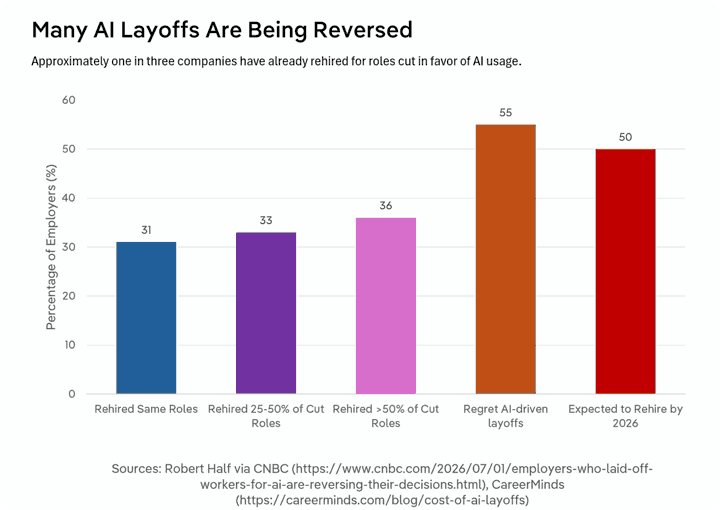
- AI-driven layoffs increasingly exhibit a "boomerang" effect: many firms that cut staff after overestimating AI capabilities are now rehiring into the same or similar roles, especially in customer service.
- The Doorman Fallacy is apparent as AI mainly boosts productivity for workers on simple, routine tasks; it does not replace the judgment and relationship-building of experienced staff.
- Companies that treat whole jobs as fully automated are seeing more complaints, legal trouble and costly rehiring.
The "doorman fallacy," a concept coined by advertising executive Rory Sutherland in his 2019 book Alchemy, describes the error of reducing a role to its most visible, mechanical task while ignoring its intangible, harder‑to‑measure functions, like status, deterrence, judgment, trust and relationship‑building.
In Sutherland's original example, a hotel that replaces its doorman with an automatic door saves on the cost of "opening a door" but loses the doorman's role in reassuring guests, discouraging bad actors, hailing taxis and signaling prestige. The hotel has lost the doorman’s judgment, discernment and relationship-building. In today's corporate context, the term has become shorthand for AI strategies that automate a job's surface tasks while discounting the human judgment, empathy and contextual reasoning that made the role valuable.
Since 2024, this pattern has become empirically visible in corporate AI deployments. A growing number of companies that replaced workers with AI systems have partially or fully reversed course after service quality declined, workloads rose, or legal exposure grew. Other companies have discovered that functions such as HR, customer service and complex engineering are more resistant to full automation than anticipated.
At the same time, credible studies show that AI does deliver real productivity gains, but mostly within bounded domains, such as novice workers performing well-defined, routine tasks. The evidence supports a more nuanced view than either "AI will replace all jobs" or "AI is useless." It is equally important to note both the sources of AI's real value and the roles in which human labor has remained durable.
Corporate reversals of AI-driven workforce cuts
Several high‑profile cases illustrate how the doorman fallacy has played out in practice. In early 2024, Klarna's CEO claimed its OpenAI‑powered assistant was doing the work of 700 full‑time customer service agents and handling roughly three‑quarters of support chats. The company froze hiring and headcount fell by about 22%, largely via attrition. , resuming hiring for human customer support and reassigning engineers and marketing staff into support roles via an internal talent pool. The CEO publicly acknowledged that while AI was cheaper, it produced lower‑quality outcomes. External reporting linked the reversal to deteriorating customer satisfaction and public complaints, ultimately damaging consumer trust in the brand. Klarna also invested in retraining workers for roles, such as interior design consultants, that leveraged human capabilities AI could not replicate.
Commonwealth Bank of Australia (CBA) introduced an AI voice bot and announced 45 job cuts, claiming the bot reduced weekly call volumes by about 2,000. The Finance Sector Union disputed this, arguing that call volumes were rising and that staff were being pushed overtime while team leaders answered calls themselves. Under union pressure and facing a challenge at the Fair Work Commission, CBA reversed the redundancies, formally calling the decision an "error" and apologizing for failing to consider all relevant business factors. Affected staff were offered their original roles, redeployment or exit packages. This reversal was confirmed in public tribunal records.
IBM's AskHR assistant automates 94% of routine HR queries, including pay statements, vacation requests and basic policy questions and the company acknowledges that AI has replaced "hundreds" of HR roles. IBM's total headcount grew, with freed resources redeployed into programming, sales and AI development. However, a 2026 report emphasized that the remaining 6% of HR issues, ethical judgment calls, exceptions, conflict resolution and layoffs, still required human intervention. to handle this last-mile judgment work. IBM's experience thus illustrates partial automation success alongside enduring human judgment needs, rather than a full reversal.
Ford, meanwhile, has reportedly reemployed hundreds of experienced engineers to address quality problems that automated systems could not resolve, making it a recent example of rehiring in response to automation's limits. For example, automation may flag recurring vehicle defects but cannot replace experienced engineers’ judgment in tracing their root causes and designing reliable fixes.
Surveys and forecasts support the idea that these are not isolated incidents. reveals that about 32% of US hiring managers who eliminated roles primarily due to AI subsequently rehired the same or similar positions, with the figure rising to 44% in finance. roughly one-third of companies that conducted AI-related layoffs later rehired 25–50% of cut roles and another 35.6% rehired more than half, with a third of employers spending more on restaffing than they originally saved.
Legal and reputational risks of over-automation
The doorman fallacy is not only operational; it carries legal and reputational consequences. A notable example is the 2024 case Moffatt v. Air Canada before the British Columbia Civil Resolution Tribunal. Air Canada's website chatbot incorrectly informed a customer that he could apply for a bereavement fare discount retroactively. When he attempted to do so, the airline refused, arguing that the chatbot was a separate legal entity responsible for its own actions. Tribunal member Christopher Rivers rejected this defense, ruling the airline liable for negligent misrepresentation and ordering payment of the promised discount plus damages and fees.
The American Bar Association highlighted the case as a clear reminder that companies remain liable for information provided by their AI tools, just as they are for static web content. While the monetary damages were modest, the ruling damaged Air Canada's customer‑service reputation and set a precedent now cited across the airline and travel industry. It illustrates how treating an automated system as a stand‑alone agent can fail in court, reinforcing that AI tools are ultimately extensions of the firm's obligations rather than independent entities.
Roles that have proven resilient to AI
Evidence from labor statistics and firm behavior suggests that several occupations exhibit resilience, either outright or in nuanced forms, despite aggressive automation narratives. Despite IBM's extensive automation of routine HR queries, the that employment of HR specialists will grow about 6% between 2024 and 2034, faster than the average for all occupations, with an estimated 81,800 openings per year, primarily due to retirements and career changes. IBM's experience clarifies why: the automated portion of HR work is low-value and transactional, while the remaining conflicts, ethical decisions and high-stakes personnel moves still demand human judgment. AI has shifted the work mix rather than erased the role.
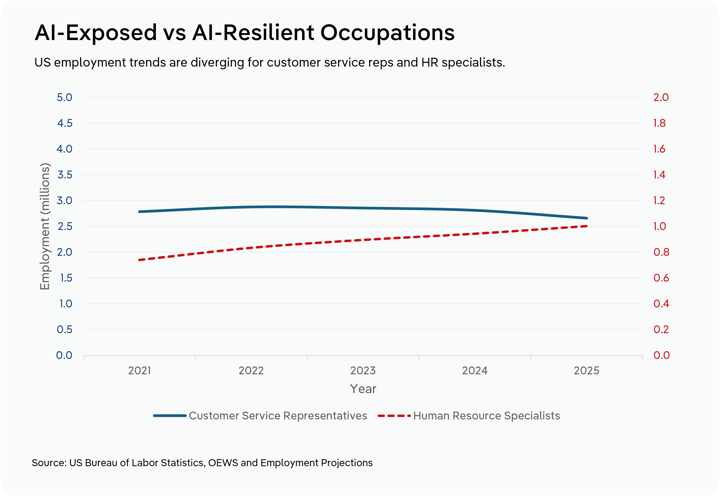
BLS projections show a long‑run decline of roughly 5% in customer service representative jobs from 2024 to 2034, reflecting the genuine automation of many core tasks. However, the Klarna and CBA cases demonstrate that, in practice, aggressive automation can increase workload and complaints, forcing rehiring even in a declining occupation. Routine scripts may be automated, but escalations, complex complaints and relationship management are not fully substitutable and misjudging this balance has led firms to restaff.
Research on Copilot reveals that AI tools can materially speed up certain tasks, but do not eliminate the need for experienced engineers. found that developers using Copilot completed a coding task 55.8% faster than the control group and had a higher task completion rate. Yet a broader, across nearly 800 developers found no significant improvement in cycle time or pull‑request throughput and recorded a 41% increase in introduced bugs among Copilot users. Ford's rehiring of seasoned engineers for quality control underscores the point. AI accelerates code generation in bounded contexts, but architecture, debugging complex systems and quality assurance remain heavily human‑dependent.
Where AI delivers verified productivity gains
The strongest empirical evidence for AI's benefits comes from studies of its impact on routine, knowledge‑work tasks. analyzes 5,000 customer support agents handling millions of chats at a Fortune 500 software firm. With AI assistance, overall agent productivity rose by about 14% and agents handled roughly 13.8% more chats per hour. However, these gains were uneven; almost all the improvements accrued to novice and lower‑skilled agents. The bottom quintile saw throughput gains of around 35%, more than double the average, while top performers experienced near‑zero change.
The AI tool effectively captured the tacit knowledge of experienced agents. It diffused it to newer workers, compressing the learning curve so that new agents reached the six‑month productivity benchmark in roughly two months. Quality metrics, a modest increase in successful resolutions and fewer customer demands to "speak to a manager� also improved slightly, alongside lower agent turnover. These findings support the view that generative AI functions best as a knowledge‑diffusion and augmentation tool, not as a replacement for experienced workers' judgment and escalation handling.
The GitHub Copilot experiment offers a parallel story in software engineering. Within a controlled, well‑defined coding task, Copilot users worked significantly faster. Still, those speed gains did not translate straightforwardly into end‑to‑end productivity or reduced defects when examined in broader, real‑world contexts.
Together, these studies suggest that AI's verifiable benefits are narrow but important: it can speed up routine implementation and raise the floor for newer workers, while leaving the ceiling, expert judgment, complex problem‑solving and relationship‑centric work largely intact.
Final Word
Taken together, these cases support a narrower, more specific reading of the doorman fallacy as observed in AI‑driven workforce decisions. The underlying pattern remains that companies that treated entire jobs as equivalent to their most automatable tasks are now absorbing the costs of degraded service, legal exposure, reputational harm and rehiring.
Klarna's CEO has publicly acknowledged a quality shortfall and reversed hiring freezes; CBA's reversal and apology are matters of public tribunal record; Air Canada's chatbot case has established a binding precedent confirming corporate liability for AI outputs. Academic research from Stanford, MIT and Microsoft demonstrates that AI is most effective at routine tasks and boosting novice performance, while having little impact on top performers and leaving complex judgment work largely untouched.
Firms that understand this nuance will use AI to augment human labor, not eliminate entire roles. That approach is more likely to deliver genuine productivity gains. It also helps companies avoid the operational, legal, and reputational costs of the doorman fallacy.