
Key Takeaways
- The capital gains tax reform targets investor demand for existing housing but leaves supply constraints unaddressed, limiting its potential effect on affordability.
- The change extends beyond property to shares, ETFs and other assets, weakening wealth-building for wage earners investing beyond their income, not only the already wealthy.
- Taxing real gains more heavily discourages risk-taking and locks capital into existing assets, weighing on an undynamic economy already concentrated in housing and mining.
Almost every Australian who owns property, shares or a business will eventually encounter capital gains tax (CGT), and the rules governing it are about to change in a major way. CGT is the tax paid on profit made once an asset is sold. Assets include things like property, shares or business interests. In Australia, the tax is combined with the taxpayer's income, so, effectively, a net gain is added to the taxpayer's income and then taxed at their marginal rate. Since 1999, individuals have been able to apply a 50% discount to gains on assets held for more than 12 months.
That system is now changing. Beginning 1 July 2027, following legislation passed in June 2026, the system will be overhauled. The 50% discount is being removed. In its place, the assets' purchase price is indexed to inflation, so tax applies only to real gains above inflation and the gain itself is taxed at the investor's marginal rate, with a minimum of 30%. In effect, investors give up the automatic 50% discount in return for inflation protection, while the rate applied to the remaining gain is generally higher than before. The reform is framed as improving housing affordability and reducing the tax advantage that asset holders have long enjoyed over ordinary wage earners. However, this change risks being a net negative.
The Broader Economic Context
Australia’s housing problem is not just a question of who gets taxed more. It’s a structural economic issue that affects household formation, labour mobility, business confidence, productivity and Australia’s long-term prosperity. Put simply, housing in Australia has become too expensive. Too much national wealth is tied up in existing property and the country is not building enough new homes in the right places, at the right pace, or at a price that enough households can afford.
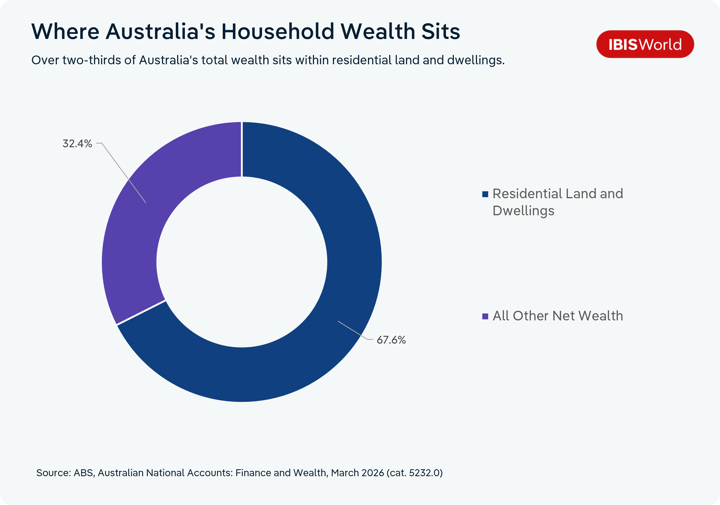
There are myriad reasons for this. Population growth has added demand. Planning and approval systems can be slow. Construction costs have risen. Labour shortages, financing conditions, compliance costs and insurance pressures have made projects harder to deliver. At the same time, housing has increasingly been treated not as a shelter, but as a primary wealth-building vehicle. This mentality has encouraged more capital to flow into existing dwellings, thereby bidding up prices without necessarily adding new supply.
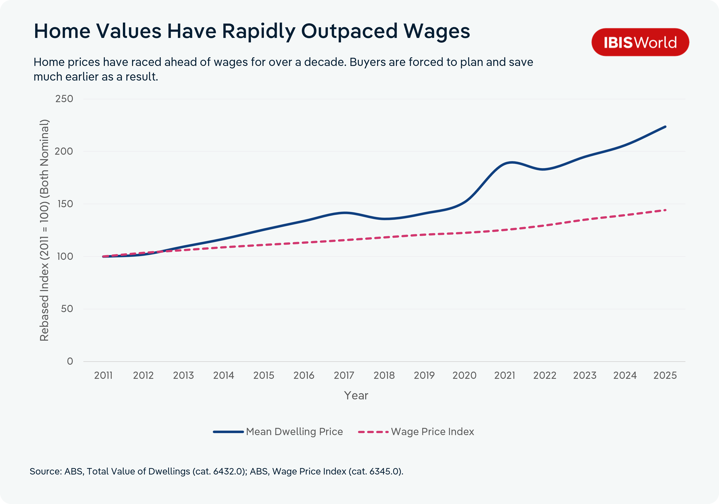
This is the broader context in which CGT reform needs to be assessed. There is a legitimate concern that Australia’s tax system has encouraged too much investment in existing housing and made it harder for first-home buyers to compete. There is also a legitimate concern that poorly designed tax reform can weaken investment incentives, discourage risk-taking and reduce the flow of capital into productive parts of the economy. Both points matter.
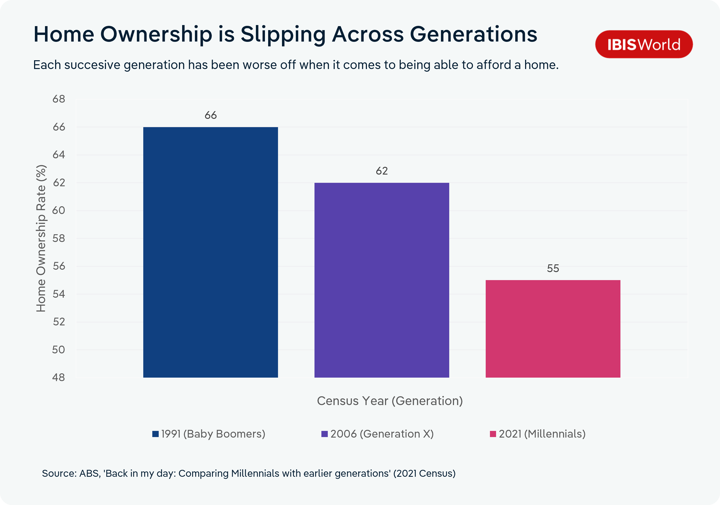
The key question is whether this reform can meaningfully improve affordability by reducing excess demand for existing housing and encouraging more investment in new supply, or whether it mostly raises the tax burden while doing too little to address the demand and supply pressures that make housing expensive in the first place.
The Reform
The 2026-27 Federal Budget’s CGT reform is now law, following the passage of the legislation and Royal Assent in June 2026. From 1 July 2027, the CGT will shift from a system of applying a 50% CGT discount to eligible investment holdings, with the remaining gain taxed at the investor’s marginal income tax rate, to a new system that applies cost-base indexation and a 30% minimum tax on real capital gains accruing from that date.
This is not quite a flat 30% CGT rate. It’s a minimum tax, meaning the impact depends on the investor’s marginal rate, the inflation rate, the holding period and the size of the real gain. The reform is also broader than simply replacing the post-1999 CGT discount. It brings future gains on assets acquired before 20 September 1985 into the CGT system. Gains accrued on those assets before 1 July 2027 remain exempt, but gains accruing after that date will generally be taxed when the asset is realised. This means that some long-held assets will require a valuation as of 1 July 2027, or another approved method for separating pre- and post-reform gains.
There are also more technical residency consequences, with periods of foreign or temporary residency potentially affecting access to indexation. These elements show that the reform is a broader structural change than simply adjusting the discount on assets acquired after 1999.
Proponents of the reform suggest that the current Australian tax system favours building wealth through asset gains rather than work itself. The current 50% CGT discount allows asset holders to achieve strong returns on their assets and generally pay lower tax than wage earners. Replacing it with inflation-indexed taxation of asset gains more closely matches income taxation while avoiding taxing inflation and focusing only on real gains. It also encourages less investment in assets like existing property due to higher taxation, thereby reducing demand and enabling greater access for owner-occupiers.
The government would also argue that the reform is prospective because gains accrued before 1 July 2027 retain the existing treatment, meaning that qualifying new builds and affordable housing retain more favourable treatment and the four existing small-business CGT concessions remain in place. The turnover threshold for the 50% active-asset reduction has also been increased from $2.0 million to $10.0 million, while a separate concession for eligible start-up investors is in development following consultation. Some of these small-business, start-up and new-build details still require later legislation and should not yet be treated as final.
Supporters would further argue that the additional revenue raised by the wider package helps fund tax relief for workers, rather than simply disappearing into general government revenue. This lens suggests that the reform is targeted rather than indiscriminate.
So why would one be cautious about this policy? In theory, it seems like a reasonable idea to level the playing field for wealth-building and favour the everyday worker. However, that view may be too narrow if it doesn’t adequately capture what is beneficial to Australia’s broader economic prosperity.
One of the policy’s key aims is to make housing more affordable. It theoretically achieves this by making existing property investments less lucrative, as the new changes ensure investors pay more tax on many high-real-gain assets, particularly where returns significantly exceed inflation. However, a major issue with the CGT change is that it risks weakening wealth-building across the board.
For young Australians earning a wage less than $100,000 per year, purchasing a house is already immensely difficult, and if done through a first-home buyer scheme, it typically involves taking on substantial debt. One mechanism many people use is building a share, crypto or similar portfolio to generate wealth beyond their income-earning potential. What this change does is make that avenue less lucrative in many cases, as it’s less tied to the investor’s actual income position once the 30% minimum tax applies and no longer has the CGT discount. This means gains are taxed at a higher rate for many investors and assets, with less difference across income brackets.
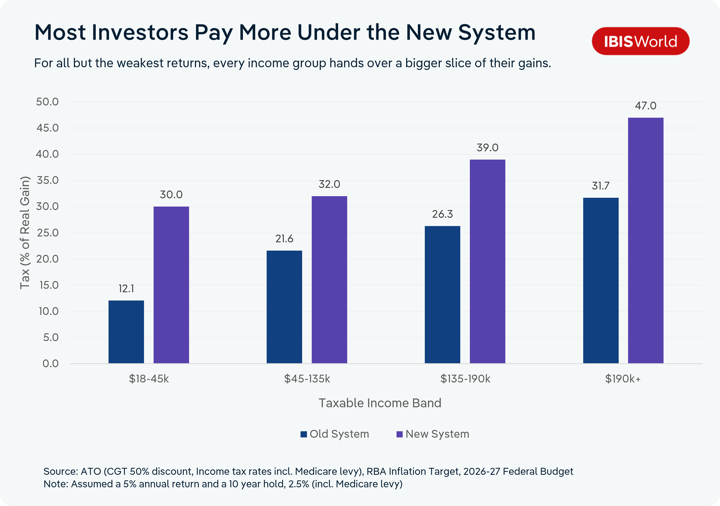
That point should not be overstated. Some investors may be no worse off or may even be better off, under indexation, depending on inflation, the holding period and the return achieved. However, as the real return exceeds inflation, the likelihood that the new system will produce a larger tax bill also increases. For assets that generate strong real gains, which are precisely the assets people often rely on to build wealth, the upside is expected to be taxed more heavily.
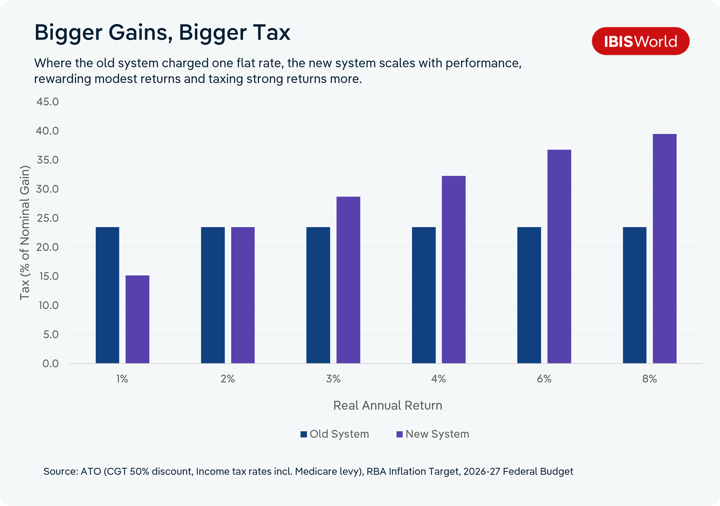
Now, if housing affordability is the goal, then yes, house prices may come down. However, if people can’t build wealth like they used to, then actual affordability may not have improved. The clearest winners are individuals who don’t own assets like shares and are looking to buy a property from their wage alone. That is a real group that matters, but it’s not the only group affected by the policy.
Second-order effects are also important and appear to be much broader as well as more integral. The CGT changes disincentivise risk-taking across the whole economy. This is key because incentives are central in economics. They may not be felt right away because of existing habits, but over time they drive behaviour. Risk itself is also a key factor, as it’s what allows the economy to grow and move beyond stagnation or decline.
The major issue is that the CGT changes don’t just apply to property, but also to productive assets like shares, ETFs, crypto and many private investments. The government retained the four existing small-business CGT concessions and moved to lift the turnover threshold for the 50% active-asset reduction. It also announced, following consultation, a separate concession for eligible start-up investments, including certain low- or zero-cost-base interests, though this remains unlegislated.
That is a meaningful concession and should be acknowledged, but it also proves the point. Once a broad capital tax change starts threatening productive investment, the government has to patch the system with carve-outs. Those carve-outs may reduce the damage for some businesses, but they don’t remove the broader investment disincentive. They also make the system more complex and leave investors asking which forms of risk-taking the government considers acceptable and which it doesn’t.
There is also a lock-in effect, as higher CGT can lead investors to hold assets they would otherwise sell simply to avoid triggering a tax liability. That slows the reallocation of capital from older or less productive investments into newer, higher-growth opportunities. It also worsens the asymmetry of risk, as the investor bears more of the downside if the investment fails, while the government takes a larger share of the upside if it succeeds. Indexation deals with inflation, which is sensible, but it doesn’t solve the lock-in problem created by a higher minimum tax on real gains. The minimum tax may reduce one form of timing behaviour, namely the incentive to wait until a low-income year before selling, but it doesn’t eliminate the more basic incentive to defer realisation altogether when selling would trigger a larger tax bill.
A strong tax system should encourage patient investment in genuinely productive assets, not incentivise investors to hold simply because of punitive tax measures. There’s an important difference between long-term conviction and tax-driven inertia. If an investor continues holding a business, share portfolio, property or any other asset because it remains the best use of capital, that is productive. If they hold it because selling would trigger a higher tax bill, capital can stay trapped in older or lower-return assets rather than moving into newer, more productive opportunities. That is the real lock-in concern and could hurt the Australian economy.
This is not to say that any one individual will necessarily choose to take on less risk, not ever invest productively or stop investing altogether. Rather that, across the board, fewer people are likely to do so than before or simply do so in a less economically efficient way. The result is a less dynamic economy, which is a material concern.
Australia is already not a particularly dynamic economy, with so much wealth and investment concentrated in housing and mining. A policy that further weakens investment incentives outside those areas risks making the economy less innovative, less adaptable and more dependent on the same established sectors. The new carve-outs make this criticism narrower, but not weaker. They mean the strongest counterpoint is no longer that every start-up or small business is treated the same as a passive property investor would be. The stronger point is now that the reform begins with an economywide tax increase on capital gains, then relies on exceptions to avoid obvious harm. That is not clean reform; it’s a broad reform with political repairs attached. That carve-outs were needed at all speaks to it being inefficient policy to begin with.
Housing, Construction and Rental-market Impacts
Let's turn the focus now to the housing, construction and rental markets. The analysis here is intentionally confined to the CGT change and not others, like negative gearing and worker tax relief, that the government has packaged alongside it. This is not to claim that those measures aren't relevant or that they do nothing, but to isolate the CGT reform and assess it on its own merits. The distinction between likely outcomes with and without the reform is paramount, especially now that the June 2026 carve-outs and the passage of the core legislation have folded CGT into a single, broader package. So, the question is narrower but sharper. It's whether the CGT element itself, even with those additional changes, promises to incur costs that its housing benefit may not justify.
One angle suggests that the CGT changes are not necessarily anti-housing, but anti-speculation in existing housing. In theory, if investors have less incentive to buy established dwellings due to higher CGT, owner-occupiers would face less competition. At the same time, new residential property retains more favourable CGT treatment, meaning capital may be redirected away from bidding up existing homes and towards new housing supply. Effectively, this creates a wider, less competitive market for buyers like first-home buyers, while also encouraging investment into new construction. The intended preference is clear, although the final legislative boundaries of what qualifies as a new build are still being settled.
This perspective has a fundamental flaw. It assumes capital will flow neatly from established property into new construction. Some probably will, because new builds retain more favourable CGT treatment, but that doesn’t mean new construction has suddenly become attractive in absolute terms. A tax preference can improve new builds’ relative appeal, but it can’t, by itself, fix the absolute economics of building them.
Developers still need buyers, pre-sales, financing, confidence and a reasonable expectation of return before houses, apartments, townhouses and larger projects proceed. Investors can play an important role here because they’re often more willing to buy off the plan or take on the risk of new housing stock than owner-occupiers. Retaining the CGT discount for new builds doesn’t remove the real constraints holding construction back, including high interest rates, construction costs, insurance and, compliance costs, as well as planning delays and an ever-growing regulatory burden.
The reform does not make land, labour or materials cheaper. It does not make approvals faster. It does not make projects less risky. It simply makes new builds look better compared with other investments that are now taxed more heavily. These are the same constraints keeping Australia well behind the National Housing Accord target of 1.2 million new homes by mid-2029 and a tax preference for new builds does little to close that gap.
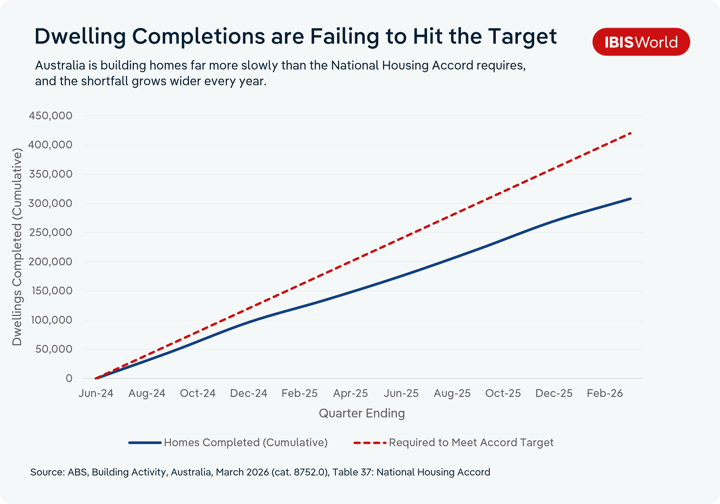
That is the key distinction. The policy may reduce investor demand for established housing, but it does little to address the deeper drivers of supply constraints. So yes, we may see some shift towards new construction, but it’s unlikely to materially change the housing shortage in an effective way.
It may also weaken the incentive to improve existing stock. If existing property becomes a less attractive investment, less capital may flow into renovations, rental upgrades and small-scale improvements. The size of that effect is uncertain because repairs, capital improvements and additional dwellings can receive different tax treatment, but the broader incentive problem remains. The result is that, over time, established housing may be of lower quality than it otherwise would have been.
The rental-market impact is similarly complex. In the short term, the reform appears to help buyers as some investors are incentivised to sell. This increases the number of established homes available to owner-occupiers. On the surface, that looks positive, but it’s worth going further.
If an investor sells to a renter who then becomes an owner-occupier, the immediate rental effect can be neutral: one rental home leaves the market, but one renter household also leaves. The problem is that this is only one scenario and it mainly captures the transition period. In other situations where the buyer wasn’t already renting – for example, someone living with parents, moving from overseas, separating into a new household, upgrading or downsizing – then a rental property is removed from supply without a matching fall in active renter demand.
More importantly, once the initial wave of investor selling passes, the market normalises with fewer investors willing to own and provide rental housing. Unless enough new rental supply is built to replace what leaves the market, the balance shifts against renters. However, as already discussed, the policy does not make new housing any easier to build. It only makes it look better compared with other investments. Therefore, the expected result is a temporary easing in the buyer market, followed by tighter rental conditions. In other words, the policy doesn’t solve the pressure so much as shift where some of that pressure is felt, from buyers to renters. Even if the rental impact is modest, as suggested by Treasury’s modelling of the combined CGT and negative-gearing package in the 2026-27 Budget, that modelling doesn’t cleanly isolate the effect of the CGT change itself. The policy still relies on new supply arriving fast enough to absorb the shift. That is a major assumption, not a guarantee.
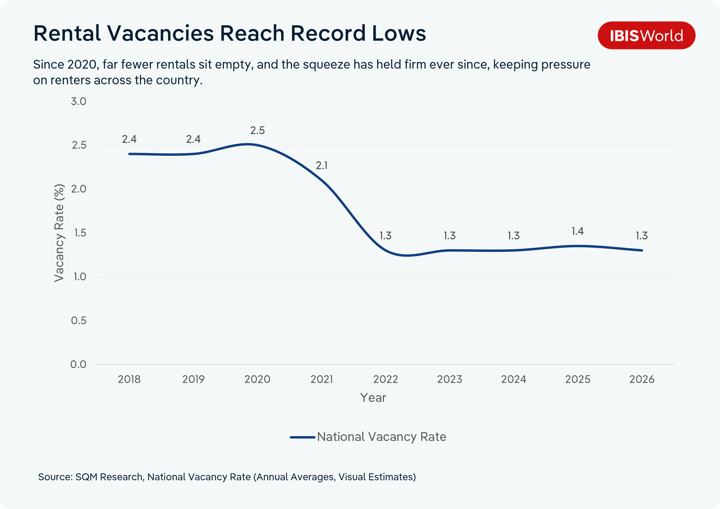
The new CGT change looks less like serious housing reform and more like a tax increase presented as affordability policy. The aim of CGT reform is to reduce speculative demand and redirect capital to new housing. However, the policy asks the whole economy to absorb a broader tax burden in exchange for a housing outcome that’s unlikely to materially improve affordability. The government’s latest carve-outs soften the political edges of the reform, especially for small business and start-ups, but they don’t change the existing constraints on housing supply and population growth-driven demand will only continue.
Wealth-building Capabilities
The policy may also entrench wealth inequality, even though it’s sold as a way to reduce it. Proponents of the policy would suggest that asset holders pay more tax, so wealthy people pay more, but that misses the important distinction between people who already have wealth and people still trying to build it.
Someone who already owns substantial assets remains wealthy; their future gains may simply compound at a slower rate. However, someone starting from a wage, trying to build capital through shares, ETFs, business equity or other investments, loses part of the pathway that allows them to move up in the first place. Asset appreciation is one of the few mechanisms ordinary people have to build wealth beyond labour income. The reform is prospective, so it doesn’t confiscate past gains, but that’s not the point. The issue is the future pathway. It makes the next dollar of wealth harder to build for people who do not already have much of it.
There is also another distortion worth considering. A principal residence remains broadly exempt from CGT and superannuation remains tax-advantaged, while many directly held shares, funds and private investments face heavier treatment. That can push people further towards concentrating their wealth in housing and superannuation, and Australia already relies too heavily on housing as its dominant wealth-building vehicle.
The current tax system already pushes wealth-building into housing and superannuation. Taxing non-housing, non-super investment more heavily makes Australia even more dependent on those channels. If that pathway is taxed more heavily, the established wealthy are merely inconvenienced, while those still trying to build wealth are left watching the ladder being pulled up behind them. While the policy is effectively framed as taxing the rich, it risks widening the gap between those who already own assets and those still trying to acquire them.
Going deeper, this gets back to the idea of incentives, a foundational concept in economics. People build, invest, start businesses and take risks when the potential upside is worth the uncertainty. If the state takes more of that upside, while individuals still bear most of the downside, fewer people will take the same risks at the margin. The effect may not play out immediately, but over time, incentives matter and take centre stage.
The reform does not distinguish well between speculative gains and productive risk-taking. It taxes both through the same broad CGT mechanism. The fact that the government now needs carve-outs for small business and start-ups is an admission that this distinction matters. These carve-outs protect selected categories while leaving the broader tax treatment of productive capital less attractive than before. Hence, less risk-taking means less investment, less innovation, less business formation and a less dynamic economy.
Final Word
This is a policy designed to reduce inequality, but it risks entrenching it by making it harder for people without assets to build them in the first place. It doesn’t fix housing supply or address construction constraints, instead weakening wealth-building pathways and discouraging risk-taking. The latest June concessions reduce some of the worst risks, but they don’t remove the core problem. A housing policy should make housing easier to build and buy. This one mostly makes some existing investments less attractive, then hopes capital moves where the government wants it to go. For those reasons, the CGT changes risk being a net negative.
On balance, the case for the reform in its current form is weak. The more defensible course is to substantially amend or repeal it and redesign around the supply and investment constraints it leaves untouched. Retaining it can be justified only if paired with genuine structural reform and even then, the expected housing benefit is unlikely to outweigh the broader economic cost.